
Start a Whitfield County Former-Owner Timeline
A table keeps names from drifting apart. Log the date, grantor, grantee, deed type, and book/page. The newest recorded grantee anchors the Whitfield County chain, and that deed's grantor becomes the next name searched backward.
| Source | Years It Covers | Where Held | What It Shows |
|---|---|---|---|
| Current Kofile deed index | 1971-present | Online and Clerk | Grantor, grantee, date, deed pointer |
| Kofile historic index books | 1852-1970 | Online book images | Older name and book/page references |
| Separate grantor/grantee runs | 1852-1954 finding sets | FamilySearch/GAGenWeb guides | Book-by-book fallback |
| Plats, probate, tax material | Varies by series | Clerk, library, archives | Land identity and indirect owner clues |
Start online for a modern Whitfield County transfer. Deeds before 1971 live in the historic index instead. The Clerk of Superior Court at 205 N Selvidge Street in Dalton remains the local custodian and the fallback for an image, an unclear index entry, or an archived volume. The Whitfield historic deed index displays its deep-book route into those older records.
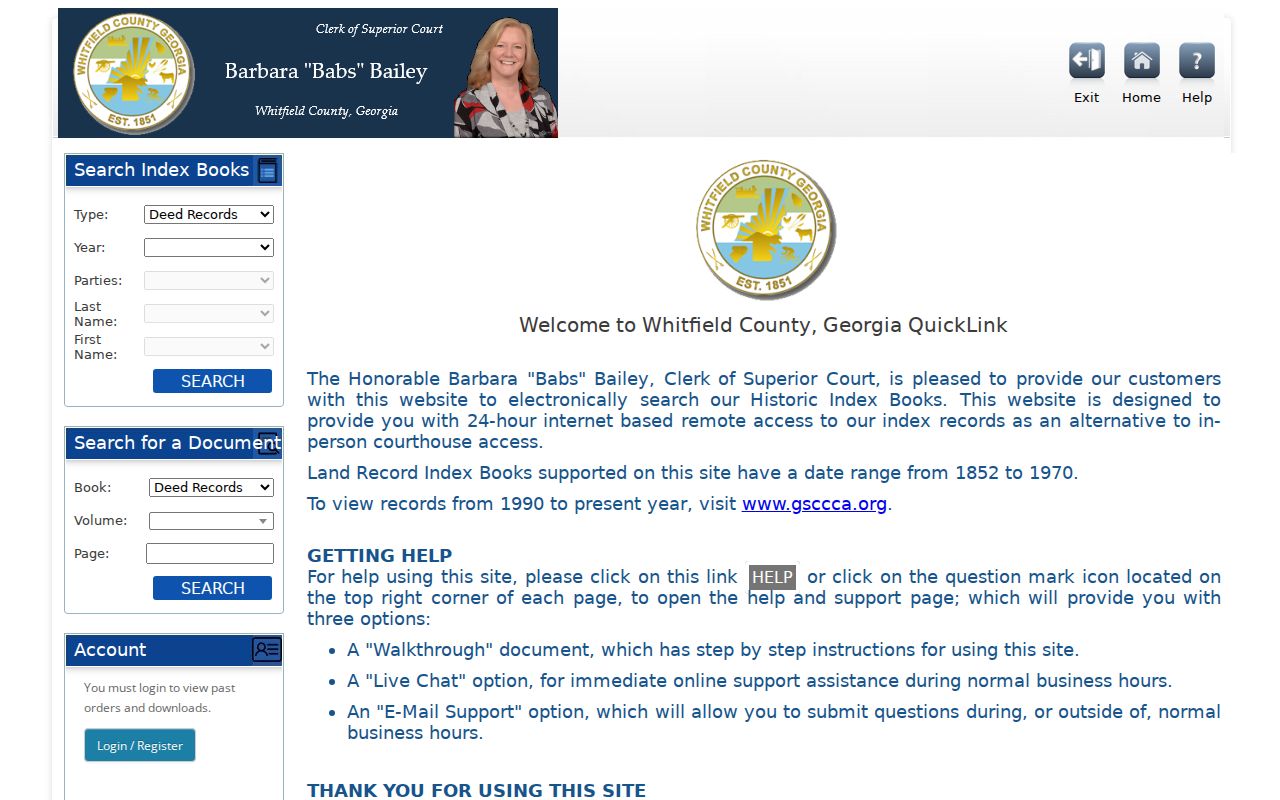
The historic index bridges 1852 to 1970. Every reference still must be traced to the deed image and matched against the legal description before a prior Whitfield County owner counts.
Cross Whitfield's 1971 Deed-Index Cutover
The current Kofile system covers Whitfield County deeds from 1971 forward, liens from 1990, and plats from 1992. Those cutoffs differ. A former-owner search follows the deed range. A lien or plat may need another source. The statewide GSCCCA Real Estate Search adds deed, lien, plat, and PT-61 entry points across counties. Its premium remote material is account-gated, though, and the local clerk stays authoritative for images.
Note: Online deed coverage reaches 1971 in the current index; Whitfield's historic index extends the name trail back to 1852.
Read the Instrument Reason Before Naming a Prior Owner
A deed date does not always mark an arm's-length sale. Gift, quitclaim, estate, trustee, government, and market transfers can all move an interest in Whitfield County land. They can also clarify one. A deed of gift can show a zero price. That zero does not erase the conveyance. Continue the chain with the grantee and the legal description. A record may say “WILLS/ESTATES/TRUSTEES DEEDS/TRUSTS.” Inspect the deed image and the relevant probate source rather than treating the event as an ordinary purchase.
Let Whitfield Legal Descriptions Survive Address Changes
Older Whitfield County land may carry a district, land lot, road, creek, subdivision, lot, unit, or metes-and-bounds description instead of a modern street number. Copy that text at every step. A repeated description is strong evidence. It shows that similarly named people and shifting addresses still concern the same tract.
- Grantor
- The party conveying the stated interest.
- Grantee
- The party receiving it.
- Reverse index
- An index organized to find a party in the opposite role.
- Chain of title
- The ordered set of instruments affecting the land.
- Warranty versus quitclaim
- Different deed forms whose legal effect must be read in the instrument.
The 1864 Fire Did Not End Whitfield's Chain
The 1864 courthouse fire did not destroy Whitfield County records. Assume nothing from the fire alone. A target volume may still be original, reconstructed, microfilmed, indexed, or held only by the custodian. When an index reference fails, write down the exact spelling, year, book/page, index side, and source searched. Ask the Clerk or archives about that volume. Resist declaring all earlier Whitfield County ownership lost.
Walk the Whitfield County Deed Chain Backward
Run each name as both grantor and grantee. Test spelling variants too. The deed image, not the index row alone, supplies the legal description and full terms that decide whether the Whitfield County chain continues.
- Find the newest deed and record its grantee, grantor, date, type, and book/page.
- Match the legal description to the subject parcel.
- Search the grantor as a grantee in an earlier deed.
- Repeat, noting gifts, estates, quitclaims, lot splits, and description changes.
- At 1971, continue through the historic index books toward 1852.
- Book/page
- The clerk location for the recorded instrument.
- Legal description
- The land identity that outlasts street-address changes.
- PT-61
- A Georgia transfer record that may add sale context.
Use Whitfield Probate, Tax, and Directory Clues
An estate transfer may need a probate clue before the next deed makes sense. Tax digests place a name near land. Dalton's digitized directories help most for addresses. Eleven searchable volumes span 1940 through 1963, with street and neighborhood indexes that tie an old address to a household. These are supporting sources, not substitutes for conveyances. Save the directory year, page, address, and census date. Then test the name against Whitfield County deeds, and use the Whitfield deed records guide for a closer look at deed images.
Test a Whitfield Former-Owner Chain Row by Row
The Lemus parcel sample in Whitfield County shows the method at work. Its chain runs through Lemus, Lopez, Pippin, and Miller. The surname string alone proves little. Each transition must preserve its transfer date, deed reason, price context, and book/page, and stay attached to the same legal description.
| Transfer date | Grantor to grantee | Deed type or reason | Book/page |
|---|---|---|---|
| Newest first | Read directly from the latest instrument | Market, gift, trust, estate, or other stated reason | Copy exactly |
| Next earlier | Search the latest grantor as an earlier grantee | Inspect rather than infer from price | Match legal text |
| Continue backward | Repeat the paired-name step | Flag partial-interest or quitclaim events | Cross the index cutoff as needed |
A break does not mean there was no owner. It may hide a spelling variant. An estate transfer, a deed recorded under another party, a lot split, or an image with no remote access can all break a Whitfield County chain, so document the gap and switch sources.
Connect Whitfield Former Owners to the Original Lot
A subdivision plat can explain why one parent tract became many lots. It explains a missing lot number on older deeds. Search by subdivision, district, land lot, and parcel, then carry the plat reference into the older deed review. Rural chains run differently. Road, creek, acreage, and metes-and-bounds calls carry them instead. Historic place names also persist after addresses change. Tunnel Hill's railroad identity, including the 1,477-foot tunnel cut through Chetoogeta Ridge in 1848-49, can explain a town-name clue without proving a tract sits inside today's city. Historical context narrows the search, and the deed description confirms the Whitfield County land.
Know How Far Whitfield Former-Owner Records Reach
The verified remote historic index begins in 1852, the county's organization year. Reaching that point is not the same as proving an original grant or an unbroken title chain. Index omissions, spelling changes, estates, partial interests, and land divisions can require clerk, library, archive, or professional title work.
If remote tools fail, use the Clerk counter, call 706-275-7450, or submit a focused Georgia Open Records Act request that names the book, page, party, date range, and record sought. The Act provides a three-business-day response framework, including notice when production is delayed or a record is exempt.
Historical limit. The online index trail begins in 1852. Former-owner research is not a title opinion, and it must never be used to stalk, harass, or harm a living person.