
Inside a Whitfield County Property Tax Record
Two offices split the record. The Board of Assessors keeps parcel details and values, while the Tax Commissioner handles the bill, payments, and past-due rules. Match the parcel number across both before comparing any amounts.
| Field | What It Shows | Where |
|---|---|---|
| Fair market value | The assessor's January 1 estimate of full value | Assessor parcel card |
| Assessed value | The statutory assessment component used before exemptions and millage | Assessor and tax account |
| Land and improvements | Separate contributions of land and structures to value | GIS parcel detail |
| Exemption code | Relief applied to an eligible account, including homestead categories | Assessor record |
| Bill and status | Amount billed, due date, payment, balance, and prior-year links | Tax Commissioner |
| Tax district | County, school, municipal, and other applicable components | Parcel card and bill |
A sale price records what actually changed hands in a deed, backed by a PT-61 filing pointer. Fair market value is different. It is an administrative estimate the county produces. Assessed and taxable figures sit further down the calculation chain. Watch for zeros: a zero sale amount can signal a gift, and a zero assessment often marks exempt government land. Neither means the property has no value.
Whitfield Values Are Fixed to January 1
Georgia assesses property based on who owned it and its condition on January 1. WhitfieldPay states that the Tax Commissioner bills the January 1 owner and never splits the year's taxes when a sale happens later. Closing paperwork can divide the cost privately between buyer and seller. The public account still follows the county's annual rule.
That timing creates a puzzle some buyers run into. A deed recorded last month can sit beside a bill naming the previous owner, because the assessor transfers title only after recording while the bill stays fixed to January 1. Check the Clerk of Superior Court's deed index for recent transfers. The name on the bill is not the final word on title.
What does "owner" on the bill mean? It names the person or entity billed under the annual rule, not necessarily the current legal owner after a midyear conveyance.
Note: No official source gives a typical refresh window for Whitfield parcel cards, so confirm the recording date directly.
The Whitfield 40% Calculation and Dalton's Exception
Georgia's standard math starts with fair market value. Multiply by 40 percent and you get assessed value. Exemptions then shrink the taxable base, and millage rates across the relevant districts produce the final bill. That sequence matters for disputes: contesting the market value, fixing a missed exemption, and challenging a rate are separate jobs for separate offices.
Whitfield County quirk. WhitfieldPay's official explanation says Dalton City and Dalton Public Schools include a 100% assessment component. Always read the parcel's tax district and actual bill rather than applying the general 40% shortcut to every Dalton account.
Dalton, Varnell, Tunnel Hill, and Cohutta each receive local distributions, as the Tax Commissioner's general information explains. A mailing address can be misleading here. The postal city, the incorporated boundary, and the tax district do not always match, so rely on the district field on the parcel record.
Land, Improvements, and Whitfield FMV History
The public GIS parcel card gives the clearest field-level picture. It works even when the assessor's home interface is down. One residential example splits land value from residential improvements. It shows both current and previous FMV, plus annual FMV history across several years. Acreage, building type, year built, condition, heated area, baths, legal description, and tax district all appear on the card. Owners can check whether the assessment describes the right parcel. They can also confirm it lists the right structures.
See the official Whitfield parcel-detail example below.
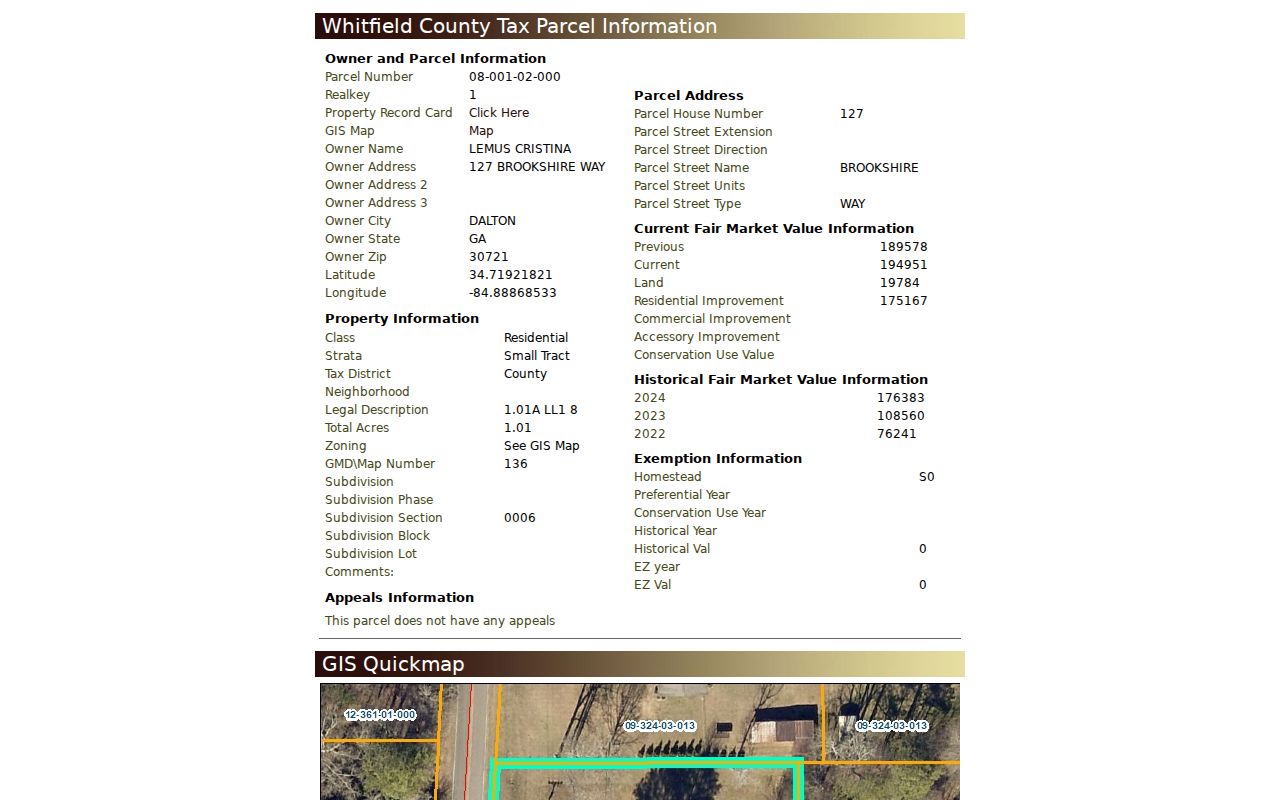
That parcel detail shows why the number, FMV, land, improvement, exemption, sale, and bill links belong together. Treat it as an administrative record. It is not a private appraisal for a transaction.
Whitfield Homestead Codes and Filing Rules
The assessor's homestead exemption guidance ties eligibility to owning and occupying the home on January 1. One homestead is allowed per family. Codes on Whitfield parcel cards include S1, S1-V, S3, S4-7, S5, and S0. A code alone proves little. Check it against the owner's actual qualification instead of decoding it from memory.
The downloadable forms page carries real-property returns. It also carries conservation-use and forest-land materials, homestead applications, and appeal documents. Filing is only the first step. An approved exemption shows up on the roll as a code. Verify it after processing. Contact the assessor if it is missing or wrong.
Look Up a Whitfield County Tax Bill
Begin at the official WhitfieldPay gateway instead of trusting a balance copied onto another site. Keep the full parcel number intact, leading zeroes and hyphens included. The same identifier then lines up with GIS and assessment records.
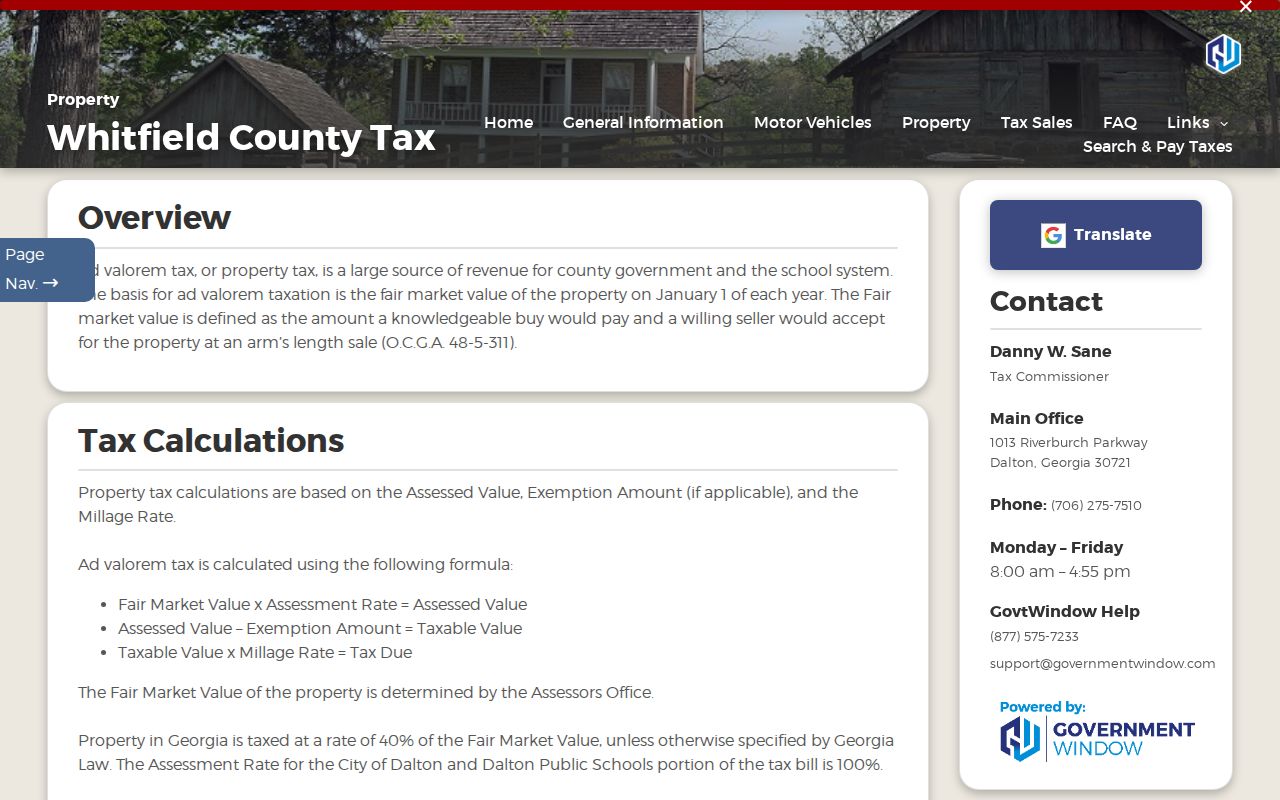
The county's payment page lays out the account and payment route. Compare its bill year and balance against the assessor's dates and the recorded deed.
- Search from WhitfieldPay's property route, preferably with the exact parcel number; use the address when that key is unknown.
- Open the current account and record the tax year, bill number, FMV, assessed value, due date, payment, and remaining balance.
- Follow any prior-year links and compare the exemption code and tax district to the assessor/GIS card.
- If a balance is delinquent, check the official tax-sale route and contact the Tax Commissioner before assuming a sale is scheduled.
- Assessed value
- The percentage-based value used as a starting point for the tax calculation.
- Millage
- A rate applied to taxable value for the relevant county, school, city, or special component.
- Homestead exemption
- Approved relief that reduces qualifying owner-occupied property taxes under stated rules.
- Tax lien
- A public claim arising from unpaid property taxes; verify its status and any release with the custodian.
When the web route fails, call or visit the Tax Commissioner at 1013 Riverburch Parkway in Dalton, 706-275-7510, Monday through Friday, 8:00 a.m. to 4:55 p.m. For non-exempt county administrative material not posted online, Whitfield's open-records form allows viewing or copies and describes a three-business-day response when records are readily available.
Delinquent Whitfield Taxes and Tax-Sale Status
Unpaid Whitfield County taxes show up in two places. Check the parcel account first. Then check the official tax-sales page, which names the responsible office and the route it uses. The county publishes no fully searchable online sale list there, so a third-party notice about a Whitfield County property should be treated as a lead rather than proof.
Work from the parcel number and legal description. Confirm the tax year, the current balance, any accrued amounts, and published sale information before drawing conclusions. Payment, cancellation, or redemption may have already changed the status. Recorded liens and releases can also surface in the Clerk's real-estate index, and a delinquent tax bill by itself never proves that a tax sale occurred.
Appeal a Whitfield County Assessment
Owners who disagree with a valuation have two paths. The Whitfield assessor appeal instructions cover both online and in-person filing, and they identify form PT-311A as the starting document. From there, an appeal can go to the Board of Equalization or to arbitration, depending on the route the owner chooses. Either way, Superior Court review remains available if the prescribed process is followed through.
Strong evidence wins these cases. Bring the assessment notice, the current property card, and correct land and improvement characteristics for the parcel. Comparable arms-length sales help most. Photographs, plats, and any documented error in the property records round out a solid file, so the assessor sees exactly what the owner sees.
Appeal window. Whitfield assessment appeals must be filed within 45 days of the annual notice. Follow the instructions and deadline printed on the notice; questioning a later tax bill does not substitute for a timely value appeal.
Keep the scope clear. An appeal questions the assessor's value or classification. It does not question the existence of a recorded deed or the accuracy of a surveyed boundary. For boundary questions, the legal description in the Clerk's recorded plat or deed controls. Whitfield parcel maps supply the map context. Whatever the dispute, preserve a dated copy of the filing along with every exhibit.